Case Study 02
AI Lead Qualification System
Case Study
Adding intelligence to the lead management process.
AI • Lead Qualification • CRM • Workflow Automation
Executive Summary
Not every lead deserves the same level of attention.
For growing service businesses, sales teams can spend significant time manually reviewing inquiries, determining whether they are qualified, and deciding which opportunities should receive immediate attention.
This project demonstrates how AI can be introduced as an intelligence layer inside an existing lead management process.
Business Problem
Leads can arrive through:
- Website forms
- Advertising
- Phone calls
- Referrals
- Social media
- Other marketing channels
However, incoming leads are often treated equally.
Sales teams must manually determine:
Is this a real opportunity?
Is the customer in our service area?
What service do they need?
How urgent is the project?
Should someone contact them immediately?
This creates unnecessary manual work and can slow down response to high-value opportunities.
The Objective
The goal was to create an AI-assisted qualification workflow that helps sales teams:
- Evaluate incoming leads
- Score opportunities
- Prioritize high-value leads
- Summarize lead information
- Recommend next actions
- Store qualification data inside the CRM
The AI does not independently make the final business decision.
It provides structured information that helps the sales team make better decisions faster.
The Solution
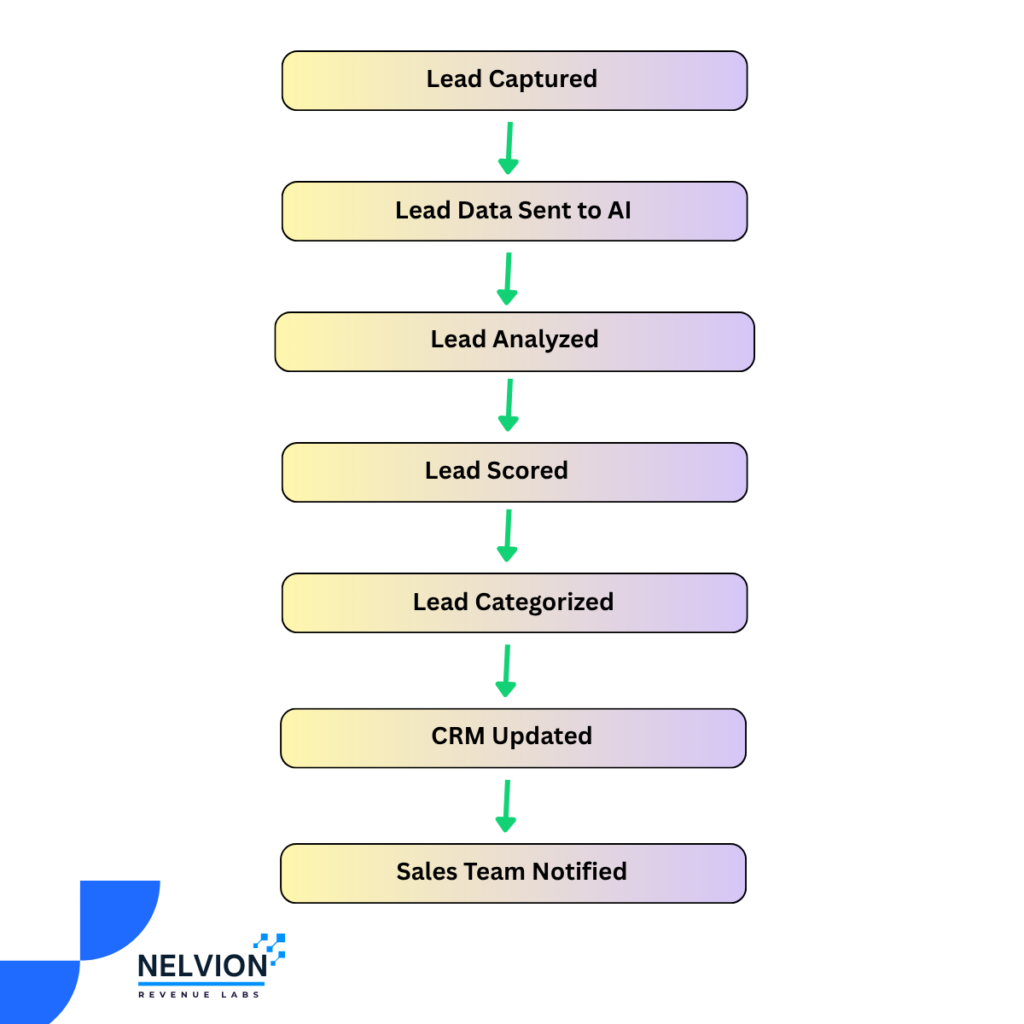
We designed an AI-assisted workflow that sits between lead capture and sales follow-up.
Qualification Criteria
The system can evaluate factors such as:
Service Fit
Does the requested service match what the company provides?
Location
Is the customer within the company’s service area?
Project Type
What type of project is being requested?
Urgency
Does the customer need the service immediately or in the future?
Budget Indicators
Are there indications of project value or budget?
Customer Intent
Does the inquiry demonstrate genuine buying intent?
Lead Scoring
The system can assign a qualification score from 0–100.
80–100 — HOT
Strong fit and high buying intent.
Recommended action: Prioritize immediate sales follow-up.
50–79 — WARM
Potential fit with additional qualification required.
Recommended action: Standard sales follow-up.
0–49 — COLD
Low fit, incomplete information, or limited buying intent.
Recommended action: Lower-priority follow-up or additional qualification.
The scoring criteria can be customized to each business.
AI Output
For each lead, the system can return structured information such as:
Lead Score
Lead Category
Qualification Summary
Recommended Action
This information can then be passed back into the CRM.
CRM Integration
The qualification information becomes part of the lead record.
Sales representatives can see:
- Lead score
- Qualification category
- Summary
- Recommended action
- Original inquiry
- Lead source
This creates a bridge between AI analysis and the existing sales process.
Technology Stack
OpenAI
AI analysis and structured lead qualification
Make / Zapier
Workflow orchestration
HubSpot
CRM and lead management
Webhooks / APIs
Data movement between systems
The architecture can be adapted to other CRM and automation platforms.
Business Impact
The system is designed to improve:
Lead Prioritization
Sales teams can quickly identify opportunities requiring attention.
Response Efficiency
High-priority opportunities can be routed into faster follow-up workflows.
Consistency
Leads can be evaluated against consistent qualification criteria.
Sales Productivity
Sales representatives spend less time manually reviewing basic lead information.
CRM Data Quality
Qualification information can be captured directly within the CRM.
Where AI Fits
This project demonstrates our approach to AI:
AI does not replace the revenue system.
It enhances it.
The underlying process remains:
Lead → CRM → Sales Process → Follow-Up → Revenue
AI adds an intelligence layer:
Lead → AI Analysis → CRM → Sales Process → Follow-Up → Revenue
This approach allows AI to create value without making the entire business dependent on AI.
Key Takeaway
The future isn’t about adding AI everywhere.
It’s about putting intelligence in the right places.
When a well-designed business process already exists, AI can enhance specific steps where analysis, classification, summarization, or decision support can create measurable value.
Systems first. Intelligence where appropriate. Human oversight always.
Explore AI for Your Business
Have a process that involves large amounts of information, repetitive analysis, or manual qualification?
Let’s explore whether AI can improve it.
NELVION GROUP LLC
Revenue Operations & Business Systems for Growing Home Service Businesses
Revenue Operations • Business Automation • Revenue Intelligence • AI Enhancement
Services
- Revenue Foundation
- Revenue Operations System
- Revenue Optimization
- AI Revenue Enhancement
Ready to Build a Smarter Business?
© 2026 Nelvion Group LLC. All rights reserved.